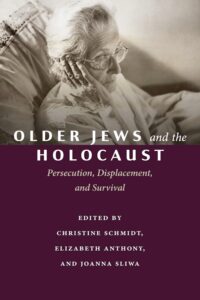
An elderly Jewish woman rescued from Theresienstadt eats a warm meal in the Hadwigschulhaus in Saint Gallen (1945) | Walter Scheiwiller / United States Holocaust Memorial Museum / Public Domain
Older Jews and the Holocaust: Persecution, Displacement, and Survival (Wayne State University Press, 2026) is a multidisciplinary volume with contributions from 16 historians. It reaches beyond the standard narrative to reconstruct the experiences of elderly Jewish Holocaust survivors with complexity and nuance. What can we learn by examining the lives and fates of elderly Jewish people before, during, and after the Holocaust? Here to answer this question are Marek Tuszewicki, Niamh Hamrahan, and Elizabeth Anthony.
Tuszewicki is an assistant professor of Jewish Culture at Jagiellonian University, Hamrahan is a doctoral graduate in Humanitarian and Conflict Response from the University of Manchester, and Anthony is the Director of Visiting Scholars Programs at the US Holocaust Memorial Museum. Recently, they sat down with Alex Rossen to discuss their contributions to this volume, which range in focus from the state of Jewish homes for the aged in pre-war Poland, to elderly Jewish migration during the Holocaust, to post-war resettlement in Vienna. This interview has been edited for clarity and length.
Alex Rossen: Marek, in your analysis of Jewish homes for the aged in interwar Poland, your sources chart a path from the end of World War I up to the liquidation of the Warsaw Ghetto in 1940. In terms of local public policy as it relates to care for elderly Jewish Poles, what changed over these years, and what did it mean for older Jewish living?
Marek Tuszewicki: The very beginning of this era was difficult for many of the institutions in the newly independent and united Poland because some of them lost their financial stability because they lost their accounts in Russian banks after the revolution. Some of them, especially from the Russian lands, were made to cope with the reality that the communities could not impose communal tax on their members, so they could not really finance those homes.
The general situation of Polish society, including the Jewish population, was very difficult at the time, economically speaking. Fortunately, there was an idea and some optimism in Poland at the early years of its independence that the society could be based on the Western model. This optimism also was based on guarantees that Jewish populations received both from the Western powers and from the Polish government that agreed that all adult members of the society, which included minorities and women, will have the power to cooperate and collaborate on the various levels of politics and to work out some kind of shape of the future society. There were some special laws introduced in Poland in the mid-1920s and in the early 1930s already, during the great economic crisis, that made it possible for those associations to receive subsidies from municipalities. Those subsidies became really the most important and most stable part of the budget until the end of this period. Until September 1939 it was the most important source of income for many of the institutions, and only after the collapse of the Polish economy in the early 1930s did some of the municipalities decide to cut those spendings.
Some of the communities took charge of the homes that previously were run by associations, and this way they were able to exist. But when you look at this most tragic moment of the Second World War, the outbreak of the war, and the first months of the German occupation, you can generally see that when it comes to the institutions that existed within the borders of the government—the parts that were only occupied but not annexed by Germany—in those cities, including Warsaw, those institutions still existed until the liquidations of the ghettos. It was only possible because of social support, very broad support of many groups and many organizations including Judenrat, or the Jewish councils. But it was a much broader phenomena, and this way, those institutions could exist.
Rossen: I want to turn and address Niamh. Your chapter reconstructs a history of two elderly survivors, Antonia Jacobi and Fanny Behrendt, who migrated to Japan during the Holocaust.
Niamh Hanrahan: The main source that I used for the chapter was a letter that’s held by the Wiener Holocaust Library in London, which was sent from Antonia to a family friend who she’s very close with, who lives in Argentina. Letters are an interesting tool for us as researchers and as historians to look for information within these categories, because they are very private spaces. They are a conversation between two people who normally know each other very well and have that common language within whatever language they’re writing in. Then a historian must come in and try to decipher, which can be very tricky. With Antonia’s letter in particular there is an added layer where the letter that was donated to the Wiener Library by her granddaughter, who, when she donated it, added annotations onto it. So then you have Antonia’s letter, but then an addition in 2011 of all her granddaughter’s addendums to the letter which says a lot more about family relations, and how these archives transform and continue in those spaces as well.
Rossen: There’s this mission stated in the introduction that one of the core goals of this book is to reach beyond the standard narrative of devastation and despair and recover a new narrative, constructed in this volume that invites more complexity and bridges different themes. Do you see your chapter intersecting strongly with that mission?
Hanrahan: I do. It provides a different narrative. These are two women traveling by themselves, and they have this small family unit. You wouldn’t think that these two women would undertake this journey without any kind of external additions to their grouping. Yet they do undertake it, and they do have these unexpected networks in Japan that help them when they arrive, enabling them to challenge authority and try to get what they need from different parts of those authorities along various points in their journey.
For example, when Antonia isn’t happy with the train class that they’re in, she will challenge that, which would push against the stereotype of someone fleeing persecution. Most people would assume if you’re fleeing persecution, you would jump on the first train and take whatever’s available to you because you’re in danger. But Antonia, in her letters, she comes across as, yes, we’re on the train, but I reserved this seat, so I demand what I paid for and what I was deserving of. On top of that, you have the geographical setting of where they’re traveling to, which shows how far people are going and how age is not a limitation.
Rossen: Elizabeth, your study of elderly Jewish survivors in Vienna focuses primarily on experiences during the immediate post-war years. What stands out about researching elderly Jewish life after the end of World War II? And what does it mean to place this research into a continuity of Jewish experiences across this period?
Elizabeth Anthony: This idea of continuity is very important to me and the kind of work that I have done overall, but also in this particular case. The people I study returned and stayed. In Vienna, there was some semblance of a formal Jewish community throughout the war. The Nazis transformed the traditional Israelitische Kultusgemeinde Wien into an Ältestenrat. After the war, it was reconstituting itself as people were returning and re-emerging from hiding or into society after surviving within the city under positions of privilege [i.e. as employees of the IKG, protected by intermarriage to a gentile, etc.]. The community immediately picked up and tried to keep on with its work and institutions.
One of the institutions that I write about in my chapter is a nursing home in Vienna that becomes a concentration camp returnee home. What I found is that it housed many elderly Jewish people over the age of 60. I defined “elderly” as 60 because of the retirement age in Vienna at the time. Practically speaking, this place had been a Jewish community nursing home before the Anschluss, which seems to account for the high number of elderly returnees housed there. A Jewish hospital of some kind had stood on that site since 1698 [except for when the Nazis took ownership in 1943-1945]. There was physical continuity.
The idea that on May 8, 1945, the war ended, was not true for everyone. Liberation was not one single moment. You didn’t go from bad times to good times overnight. I’m writing about this group which consisted of many hundreds of people who survived camps, mostly Theresienstadt, which at the time they were qualifying as a camp. They returned home and searched for shelter and where to stay after their homes had been expropriated. They had to deal with the bureaucracies of restitution. Grieving over the loss of their families and communities, all the while aging. Their bodies had undergone a lot of abuse. One of the things that stood out to me most is that we can’t let liberation mean resolution. You miss out on the continuity if you just view it as going from crisis to aftermath.
There’s a big enough group to write about, to understand more about what kind of experience that is: the part of their lives that they had as people in the post-war Jewish community of Vienna as it was reconstituting itself. These people were not only there to live out the last few years of their lives, but to resume and reclaim a place. In their Vienna, where they chose to live.
Click here to read an excerpt from Older Jews and the Holocaust: Persecution, Displacement, and Survival (Wayne State University Press, 2026).